During the summer of this year, I received complimentary tickets to Busch Gardens Williamsburg. Wife and Son had been there before. I haven't. The tickets came in three sets: one for a single-day access with free parking, one for a meal of entree and drink, and one for a souvenir cup for free refills after paying full price for the cup.

August 13. Almost 3pm. We had crossed Benjamin Harrison Memorial Bridge and en route on VA-5 to Williamsburg. The rain had started when a flash flood warning was heard on the radio. It was in effect for the rest of the day. The rain got heavier as we were approaching the turn to Jonestown Settlement. We decided to check in at the hotel instead, and figure out what to next. The plan was changed to move Busch Gardens forward and Jonestown Settlement to the next day. With the free tickets in tow, we departed to the former.
Our time at Busch Gardens is easily summed up below.

The 12 Steps at Busch Gardens
- 15-minute walk from (Germany) parking lot to Park Entrance
- from England to Scotland
- passed through Scotland, down the stairs onto boardwalk and to Germany
- from Germany to Oktoberfest
- went up to The Wolf's Revenge, turned around, passed German Pretzels & Beer
- crossed bridge to Italy, saw San Marco Theatre and Marco Polo's Marketplace
- passed The Battering Ram, went south at roundabout, arrived at Turkish Delight
- went back to Marco Polo's Marketplace for dinner, did not find anything we liked
- went back to Oktoberfest, had dinner at Das Festhaus
- went east at roundabout, arrived at Escape From Pompeii
- went to England to purchase two souvenir cups for Wife and Son
- left Park Entrance for 15-minute walk back to parking lot
What can I say? None of us were interested in trying any of the rides. We came because the tickets were free. All we did was walk. Like most amusement parks, the food left much to be desired. Service could have been better. The servers at Das Festhaus looked glum, as if they didn't want to be there. Lids were not provided for the drinking cups, and I prefer to mine filled to the brim with beverage. That led to was spillage on my tray of food when I brought it to a dining table. When a customer has paid at the cashier, they are no allowed to return for refills. My order was German sampler with a side of dill pickles. I tried to eat as much as I could. It was filling but not enjoyable.
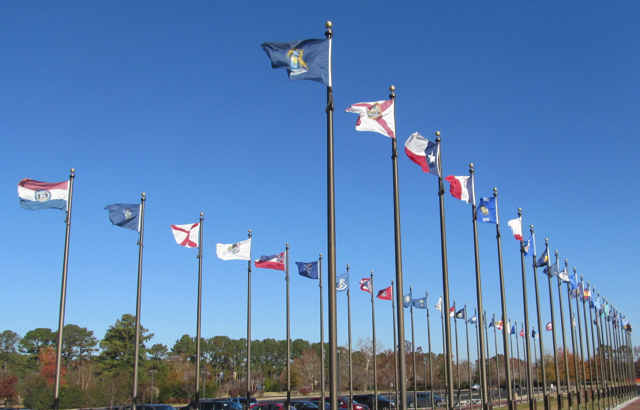
Jamestown Settlement had free parking, which was a plus. From where we parked, we crossed the zebra crossing and walked through Quadricentennial Plaza to get to the museum. Erected in 2007 to commemorate the 400th anniversary of the founding of Jamestown, the Quadricentennial Plaza's dual files of state flags was remarkable. When looking from the north side – facing the trio masts with the United States flag in the middle – the state flags were arranged in order of ratification starting from the right file with the flag of Delaware, moving state by state to the south side, then making a U-turn and continue on in the other file (with the flag of Michigan), and arriving back to the north side with the final state flag (Hawaii). A plague at the base of each mast briefly described the state's founding. An example is shown below right of the Tar Heel state.


Jamestown Settlement should not be confused with Historic Jamestowne (spelled with an extra "e"). The former is a museum located in Williamsburg while the latter is an archeological site located in Jamestown. As the map below shows, they are separate locations requiring separate tickets to visit. When we arrived at Jamestown Settlement at 11:20am, the sky was cloudy. By 2:25pm, it was sunny and clear. The below right photo shows the stark contrast.


The museum had a wide facade. When seen from an aerial view, it is shaped like an obtuse angle. Even through we went during the summer vacation, it wasn't crowded that day. If you're not interested in attending the museum, there plenty of benches to hang out by the lawn area.


The first thing we did after purchasing the tickets was to watch a movie. We went to the rotunda (amazing ceiling view), and followed the directions to Gallery Theater where we saw 1607: A Nation Takes Root. This docudrama traces the founding of Jamestown from the point of view of the colonists, the Powhatans and the Africans, with the colonists being the main protagonists (no-brainer). If I had known that the film was already available on YouTube, I'd have skipped it altogether.


After the film was over, we proceeded down Great Hall to the Galleries. What made this hall "Great"? Hmm... period architecture, lamps and chandeliers, year number of historical significance engraved above each doorway, high ceiling... I don't know, you tell me.


There were three entrances to the Galleries. We took the first one from the rotunda. As the below panorama shot shows, we were entering the "Before Jamestown" section.


Before Jamestown, life was peaceful for the Africans and the Powhatans as shown by their life-sized dioramas. Then came the stars of the Galleries: British colonists. The layout and decor for their exhibits evoked a colonial marketplace. It included a partial model of a ship.


The "1607" doorway to the right of "The Virginia Company of London" exhibit led to more exhibits. More Powhatans, including one devoted to Pocahontas.


In addition, there were exhibits about women's contributions during the early years of Jamestown. "From Africa to Virginia" was a particularly interesting treat. In front of visitors were artifacts and written displays, behind them was a long, large screen showing clips of Africans' encounter with the colonists and the subsequent development of the slave trade.


Beyond that were additional colonist exhibits. They weren't as impressive as what came next: recreated homes from that time period (early to mid 1600s). Some of them were colonist dwellings and some slave dwellings. Hard to tell which was which as they all looked similar.


At one of the homes, a video clip – played periodically on an exterior wall – showed a slave describing what life was like back then. He seemed happy, like Song of the South's Uncle Remus happy.


Across from that home was a doorway leading to Great Hall. By the doorway were written displays encouraging visitors to "Turn Legacy Into Action". To the left of the doorway were exit doors that led outside to the gazebo and an area called the Mall. The Mall had a walkway surrounding a larger lawn. At the end of the lawn towards the gazebo was the Commemoration Tower.


Ahead was a sign pointing in the direction of additional exhibits. These were recreations of a Powhatan town, a colonial fort and a harbor. We began with Paspahegh Town. The Powhatans loved their space. No fences or walls. No need for them when their biggest threats were wildlife and faraway rival tribes. The interiors of the homes looked authentic, but I regret not taking any pictures as proof.


My compliments to the interpreters – as they were called – for spending their time (all day) at their respective posts ready to demonstrate their wares and share historical factoids to visitors. Next stop was James Fort.


I wasn't as impressed as Wife and Son. They spent more time in James Fort than I did. Looking back, I wished I had taken pictures of the buildings' interiors. Among the representations were a church, a store, a kitchen, an inn, a metal forge and some cannons. The interpreters, dressed in period attire, played their parts as guard (with period firearm), cook, storekeeper and blacksmith. I did get a video of the guard demonstrating a lighter.

The one exhibit I looked forward to seeing was Ships. A recreated pier by the shore with recreated ships Discovery, Susan Constant and Godspeed. We boarded Godspeed, were greeted by its friendly crew, took the stairs at the stern and saw the captain's quarters. There was a barrel and an electric fan by the bed – the perks of being a captain. Across from the captain's quarters towards the bow were bunks for the crew. Four of them.


Below right is a YouTube video of Godspeed by JYF Museums. I could have sworn the ship in the video looked bigger than the one we saw.

We returned to the deck where an interpreter dressed as a crew member was ready to answer any questions we had. I asked him how a total of five bunks could accommodate a crew of thirteen. He said the crew took turns to rest, probably in three shifts (my guess). I then asked why Godspeed didn't have a wheel for steering. He said the ship used a whipstaff instead. The wheel wasn't used until the following century. We thanked him, stopped by Jamestown Settlement Cafe for lunch, and then headed on home. Slideshow of the colonist portion of the exhibits in the video link below right.


Jonestown Settlement turned out to be better than expected. Definitely worth the $20 single-day visit. There was plenty to see and appreciate. Or you can chill and hang out at Quadricentennial Plaza and the lawn area by the front entrance. Together, both provide the ambience of a park without a paid admission. Maybe someday I'll drop by Historic Jamestowne down the street.
No comments:
Post a Comment